
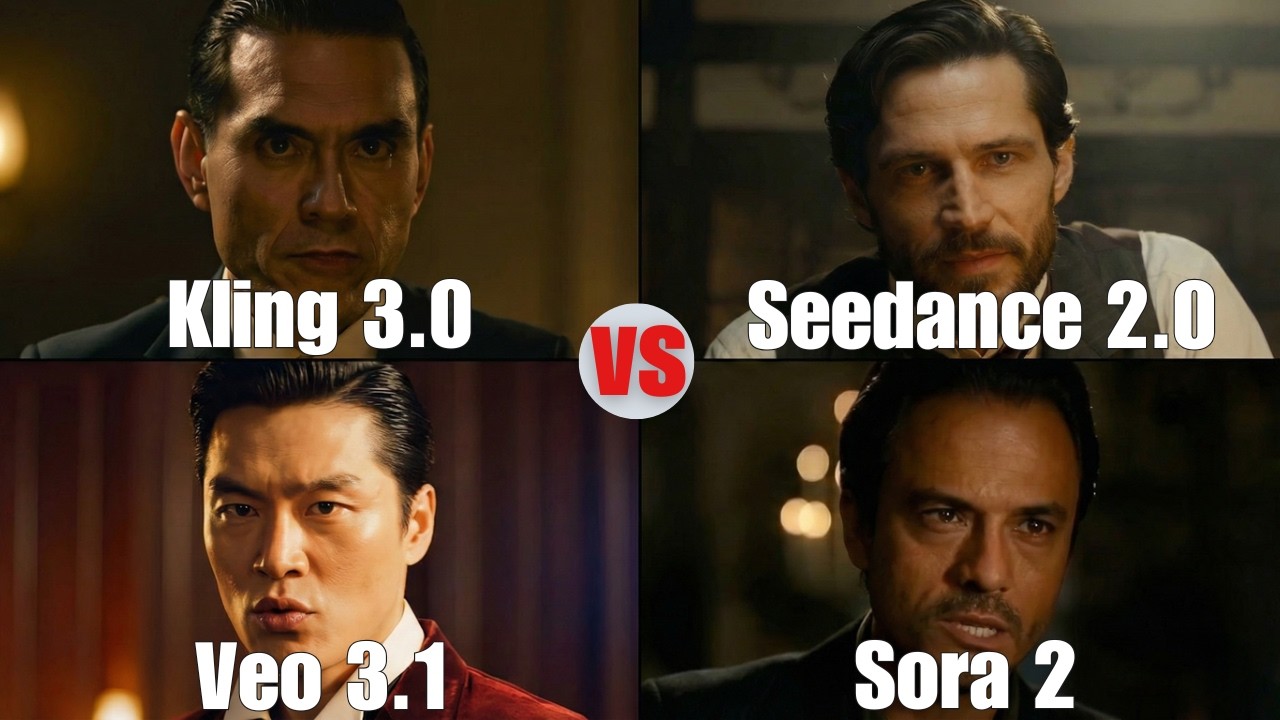
The AI Video Arms Race Is Here#
February 2026 will be remembered as the month AI video generation took a massive leap forward.
On February 5, Kuaishou launched Kling 3.0 — a model that immediately earned the title "new king of AI video generators" from multiple reviewers. Just four days later, ByteDance fired back with Seedance 2.0, and the internet lost its mind.
Both models promise cinematic-quality video from simple text prompts. Both support multi-shot storytelling. Both generate synchronized audio. But which one is actually better for your workflow?
We tested both extensively. Here's our honest breakdown.
What Is Seedance 2.0?#
Seedance 2.0 is ByteDance's latest AI video generation model, released on February 9, 2026. It's available through Dreamina (CapCut's AI platform) and Jimeng AI (ByteDance's Chinese platform).
Key Features#
- Multi-modal input: Text, images, video clips, and audio — all in one prompt
- @ Reference System: Tag specific elements (@character, @style, @motion) for precise control
- Native 2K resolution: 30% faster generation than competitors
- Multi-lens storytelling: Generate multiple scenes with consistent characters and style
- Native audio sync: Automatic voice, music, and sound effects generation
- Up to 15 seconds per generation
What Makes It Special#
The killer feature is the @ reference system. Instead of describing everything in text, you can upload a character image and tag it as @character, upload a fight choreography video as @motion, and let the AI combine them. One Chinese creator reported that what used to take his team an entire day now takes 5 minutes.
"With its reality enhancements, I feel it's very hard to tell whether a video is generated by AI." — Wang Lei, programmer, quoted by South China Morning Post
What Is Kling 3.0?#
Kling 3.0 is Kuaishou's flagship AI video model, launched on February 5, 2026. It's available through Kling AI and via API.
Key Features#
- Native 4K resolution: True pixel-level detail generation (not upscaled)
- Multi-shot sequencing: Up to 15 seconds with multiple camera angles
- "AI Director" paradigm: Generates coverage like a real film shoot
- Physics engine: Simulates inertia, weight, and collision detection
- Omni Native Audio: Synchronized voice, music, and SFX generation
- Voice Binding: Specific voice profiles attached to specific characters
- 30fps standard, 60fps in some configurations
What Makes It Special#
Kling 3.0's standout is its physics engine and photorealism. Characters exhibit authentic weight transfer, vehicles lean during turns, and camera movements include accurate parallax. The "AI Director" paradigm means you're not generating isolated clips — you're generating actual film coverage with spatial continuity across shots.
The Multi-modal Visual Language (MVL) framework processes images, video, and audio in a shared latent space, so a character created with Image 3.0 stays perfectly consistent when animated in Video 3.0.
Seedance 2.0 vs Kling 3.0: Feature Comparison#
| Feature | Seedance 2.0 | Kling 3.0 |
|---|---|---|
| Developer | ByteDance | Kuaishou |
| Release Date | Feb 9, 2026 | Feb 5, 2026 |
| Max Resolution | Native 2K | Native 4K |
| Max Duration | Up to 15s | Up to 15s |
| Frame Rate | 30fps | 30fps (60fps available) |
| Input Types | Text, Image, Video, Audio | Text, Image, Video |
| Multi-shot | ✅ Multi-lens storytelling | ✅ AI Director paradigm |
| Audio Generation | ✅ Native sync | ✅ Omni Native Audio |
| Character Consistency | @ Reference system | MVL framework |
| Physics Simulation | Basic | Advanced (inertia, collision) |
| Camera Control | Standard controls | Advanced (dolly, rack focus, macro) |
| Voice Binding | ❌ | ✅ Per-character voices |
| Multilingual Audio | Limited | EN, CN, JP, KR, ES |
| Platform | Dreamina (CapCut) | Kling AI |
| API Access | Via Dreamina | ✅ Full API |
| Free Tier | ✅ Free trial (limited) | ✅ 66 free credits/month |
Pricing Comparison#
Seedance 2.0 (via Dreamina)#
| Plan | Price | What You Get |
|---|---|---|
| Free Trial | $0 | Limited generations (currently free on Xiaoyunque App) |
| Dreamina Membership | ~$9.60/month | Full access to Seedance 2.0 features |
| Per-shot cost | ~$0.42 per VFX shot | 90%+ generation success rate |
Kling 3.0#
| Plan | Price | What You Get |
|---|---|---|
| Free | $0 | 66 credits/month (~6 videos) |
| Standard | $6.99/month | 660 credits, 1080p, no watermark |
| Pro | $25.99/month | 3,000 credits, priority processing |
| Enterprise | Custom | API access, bulk pricing |
Winner on pricing: Kling 3.0 — More transparent pricing with a generous free tier. Seedance 2.0's free trial is temporary and region-dependent.
Quality Comparison: Who Generates Better Video?#
Based on early creator feedback and side-by-side comparisons:
Photorealism#
Winner: Kling 3.0 🏆
Kling's native 4K output and physics engine produce footage that's closer to real camera work. The weight, momentum, and lighting feel more grounded in reality. Seedance 2.0 is impressive but occasionally produces slightly "dreamy" results.
Character Consistency#
Winner: Seedance 2.0 🏆
The @ reference system is a game-changer. Upload a character design, and Seedance maintains it across multiple shots with remarkable accuracy. Kling 3.0's MVL framework is good, but Seedance's explicit reference tagging gives creators more control.
Creative Control#
Winner: Seedance 2.0 🏆
The ability to combine multiple input types (image + video + audio + text) in a single prompt gives Seedance unmatched compositional flexibility. You can show the AI exactly what you want rather than describing it.
Motion and Physics#
Winner: Kling 3.0 🏆
Kling's dedicated physics engine produces more realistic movement. Characters have proper weight transfer, objects interact naturally, and camera movements include accurate parallax effects.
Audio Integration#
Winner: Kling 3.0 🏆
Voice Binding (assigning specific voices to specific characters) and multilingual support give Kling the edge. Seedance 2.0 has audio sync, but Kling's implementation is more sophisticated.
Speed#
Winner: Seedance 2.0 🏆
ByteDance claims 30% faster generation than competitors, and early users confirm noticeably shorter wait times.
What About Sora 2 and Veo 3.1?#
No AI video comparison in 2026 is complete without mentioning OpenAI's Sora 2 and Google's Veo 3.1.
| Model | Best For | Resolution | Price Entry | Unique Strength |
|---|---|---|---|---|
| Seedance 2.0 | Creative control | 2K | ~$9.60/mo | @ Reference system |
| Kling 3.0 | Photorealism | 4K | $6.99/mo | Physics engine |
| Sora 2 | Raw realism | 1080p | $20/mo (ChatGPT Plus) | Physical world understanding |
| Veo 3.1 | Google integration | 4K | Free (limited) | Google ecosystem |
According to community polls on Reddit's r/singularity, the current consensus ranks them: Seedance 2.0 > Kling 3.0 > Veo 3.1 > Sora 2 for overall quality, though each excels in different areas.
Who Should Use Which?#
Choose Seedance 2.0 if you:#
- Need precise character consistency across multiple shots
- Want to combine multiple reference materials (images, videos, audio)
- Prioritize creative control and speed
- Are comfortable with the Dreamina/CapCut ecosystem
- Work primarily in short-form content creation
Choose Kling 3.0 if you:#
- Need the highest possible resolution (native 4K)
- Want realistic physics and motion
- Need multilingual voice generation
- Require API access for production workflows
- Want transparent, predictable pricing
Choose Sora 2 if you:#
- Already pay for ChatGPT Plus
- Need raw physical-world realism
- Want the simplest possible interface
- Don't need multi-shot capabilities
The Bigger Picture: What This Means for Creators#
The release of Seedance 2.0 and Kling 3.0 within the same week signals something important: AI video generation has crossed the "good enough" threshold for professional use.
A few key trends to watch:
-
Multi-modal input is the future: Both models move beyond text-only prompts. Showing the AI what you want (via reference images, videos, and audio) produces dramatically better results than describing it.
-
The "AI Director" is real: Multi-shot generation with consistent characters means AI can now produce actual sequences, not just isolated clips. This changes the workflow for short-form content creators.
-
China is leading: Both breakthrough models come from Chinese companies. ByteDance and Kuaishou are investing heavily, and the competition is driving rapid improvement.
-
Cost is plummeting: A VFX shot that would cost thousands from a studio now costs under $1 with AI. The democratization of video production is accelerating.
Our Verdict#
If we had to pick one winner: Seedance 2.0 takes the crown by a narrow margin — primarily because the @ reference system gives creators a level of control that no other tool matches right now.
But honestly? The real winner is creators. Two world-class AI video generators launched in the same week, both offering free tiers, both pushing the boundaries of what's possible. The best strategy is to try both and use whichever fits your specific workflow.
The AI video revolution isn't coming. It's here.


