
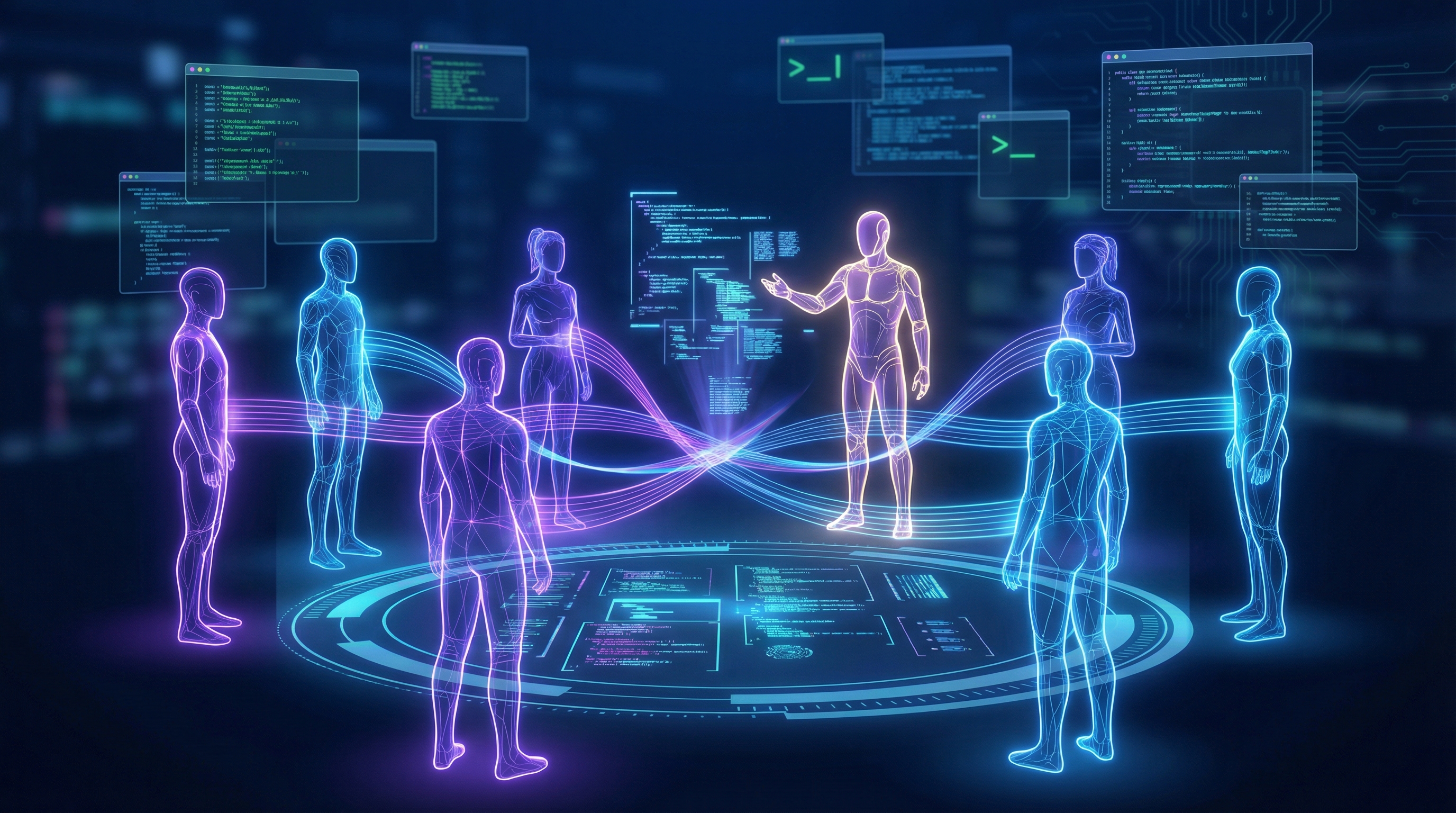
If you have been following AI coding tools, you have probably noticed the buzz around Claude Code Agent Teams this week. Anthropic quietly shipped one of the most significant features in AI-assisted development — and the developer community is losing its mind.
Here is why this matters, how it works, and whether it is worth the hype.
What Are Claude Code Agent Teams?#
Agent Teams is a new experimental feature in Claude Code that lets you run multiple Claude instances in parallel on the same codebase. Instead of one AI session handling everything sequentially, you can now spawn a coordinated team of AI agents — each with its own context window, its own task, and the ability to communicate with each other.
Think of it like going from single-threaded to multi-threaded programming, but for AI coding assistance.
The feature shipped on February 6, 2026, alongside the release of Claude Opus 4.6. It was actually discovered hidden in Claude Code's binary weeks before launch — a fully-implemented system called TeammateTool with 13 operations, feature-flagged off, just waiting for Anthropic to flip the switch.
How It Works: The Architecture#
The system has three core components:
Team Lead — Your main Claude Code session. It creates the team, defines tasks, spawns teammates, and synthesizes results. Think of it as a tech lead who delegates work and reviews output.
Teammates — Separate Claude Code instances, each with its own context window. They can read and write files, run commands, and — crucially — message each other directly. This is what makes Agent Teams fundamentally different from subagents.
Shared Task List — A central work queue with dependency tracking. Tasks have three states: pending, in progress, and completed. When a blocking task finishes, downstream tasks automatically unblock. File-lock based claiming prevents race conditions.
The inter-agent messaging system (the "mailbox") is the real breakthrough. The lead can message any teammate, teammates can message the lead, and teammates can message each other. This enables genuine collaboration — agents can share findings, challenge each other's conclusions, and converge on better solutions through debate.
Setting It Up (5 Minutes)#
Agent Teams are behind an experimental flag. Here is how to enable them:
Option 1: Settings file (recommended)
Add this to your ~/.claude/settings.json:
{
  "env": {
    "CLAUDE_CODE_EXPERIMENTAL_AGENT_TEAMS": "1"
  }
}
Option 2: Environment variable
export CLAUDE_CODE_EXPERIMENTAL_AGENT_TEAMS=1
Option 3: Per-session
CLAUDE_CODE_EXPERIMENTAL_AGENT_TEAMS=1 claude
For the best experience, install tmux so each teammate gets its own visible terminal pane:
# macOS
brew install tmux

# Linux (Debian/Ubuntu)
sudo apt install tmux
Then start a tmux session before launching Claude Code:
tmux new -s my-project
claude
The Killer Use Cases#
Not everything needs a team. These scenarios justify the extra token cost:
1. Parallel Code Review (3 Reviewers, 3 Perspectives)#
One reviewer gravitates toward one type of issue. Three catch what one misses.
Create an agent team for PR #142:
- Security Reviewer: Token handling, input validation, auth flows
- Performance Reviewer: N+1 queries, memory leaks, unnecessary renders
- Test Reviewer: Coverage gaps, edge cases, flaky test patterns
The lead synthesizes all findings into one comprehensive review. Three perspectives, one output.
2. Debugging with Competing Hypotheses#
This is the killer use case. Single agents find one plausible explanation and stop. Multiple agents arguing with each other find the right explanation.
Production API is returning 500s intermittently. Create a debugging team:
- Hypothesis 1: Database connection pool exhaustion
- Hypothesis 2: Race condition in the caching layer
- Hypothesis 3: Memory leak in the request handler
Have them share evidence and argue which theory fits the logs.
Parallel investigation with adversarial debate. The strongest theory wins.
3. Multi-Layer Feature Development#
Feature spans frontend, backend, and tests. Each teammate owns a layer:
Create an agent team with three teammates:
- Backend: API endpoints and database schema
- Frontend: Components and state management
- Tests: E2E and integration tests
They should coordinate on the API contract.
Backend finishes the API → test teammate picks up automatically via the shared task list.
The $20,000 C Compiler Experiment#
To showcase Agent Teams, Anthropic researcher Nicholas Carlini ran a jaw-dropping experiment: he tasked 16 parallel Claude agents with writing a Rust-based C compiler from scratch — one capable of compiling the Linux kernel.
The results:
- 2,000 Claude Code sessions over two weeks
- 2 billion input tokens and 140 million output tokens
- $20,000 in API costs
- 100,000 lines of Rust code
- Successfully compiles Linux 6.9 on x86, ARM, and RISC-V
Carlini's takeaway: "Agent teams show the possibility of implementing entire, complex projects autonomously." But he also noted the code quality is "reasonable but nowhere near what an expert Rust programmer might produce."
The GitHub community had mixed reactions. Some were impressed by the achievement. Others pointed out the irony of calling it "from scratch" when the model was trained on vast amounts of existing code. One commenter quipped: "If I went to the supermarket, stole a bit of every bread they had, and shoved it together, no one would say I made bread from scratch."
Agent Teams vs. Subagents: When to Use What#
| Feature | Subagents | Agent Teams |
|---|---|---|
| Communication | Reports back to caller only | Teammates message each other |
| Coordination | Main agent manages everything | Shared task list, self-coordination |
| Context | Own window, results summarized | Own window, fully independent |
| Token Cost | Lower | ~5x per teammate |
| Best For | Focused tasks, only result matters | Complex work needing discussion |
Use subagents when you need quick, focused workers that report back a result.
Use Agent Teams when workers need to share findings, challenge each other, and coordinate autonomously.
Pro Tips from Early Adopters#
Require plan approval for risky tasks. Teammates can work in read-only plan mode until the lead approves. Do not let them push to main without review.
Use delegate mode. Press Shift+Tab to lock the lead into orchestration-only mode. Leads should lead, not code.
Give teammates specific context. They load CLAUDE.md automatically but do not inherit the lead's conversation history. Be generous with the initial briefing — file paths, constraints, what "done" looks like.
Avoid file conflicts. Two teammates editing the same file = overwrites. Structure work so each teammate owns different files. If they must touch the same file, sequence the tasks with dependencies.
Start read-only. Your first Agent Team run should be a code review, not a parallelized refactor. Learn the coordination patterns before letting multiple agents write code.
Watch the token burn. Each teammate is a separate Claude instance with its own context window. Agent teams use roughly 7x the tokens of a standard session when teammates run in plan mode. Monitor costs closely.
Known Limitations#
Agent Teams are still experimental. Current limitations include:
- No session resumption — if a teammate crashes, you start over
- No nested teams — a teammate cannot spawn its own team
- Split panes require tmux or iTerm2 — does not work in VS Code terminal or Windows Terminal
- File conflict risk — no built-in merge resolution when two teammates edit the same file
- High token cost — roughly 5-7x a single session
Why This Matters#
Agent Teams represent a fundamental shift in how AI assists with coding. We have gone from "AI as autocomplete" to "AI as a coordinated development team."
The implications are significant:
- Solo developers can now run parallel code reviews, debugging sessions, and feature development — capabilities previously requiring a human team
- Development speed increases dramatically for tasks that decompose into parallel work
- Code quality improves through adversarial review — multiple agents catching what a single agent misses
The community response has been explosive. Reddit threads are filled with developers reporting that Agent Teams "finished my work" by spawning three agents that talked to each other. Open-source projects like OpenCode are already porting the concept to work with other AI providers.
Whether you are skeptical or excited, one thing is clear: multi-agent AI coding is no longer theoretical. It shipped. It works. And it is only going to get better.
Get Started#
- Install or update Claude Code
- Set
CLAUDE_CODE_EXPERIMENTAL_AGENT_TEAMS=1 - Install tmux for split-pane mode
- Start with a code review task to learn the patterns
- Read the official documentation
The future of AI coding is multi-agent by default. The switch just got flipped.


